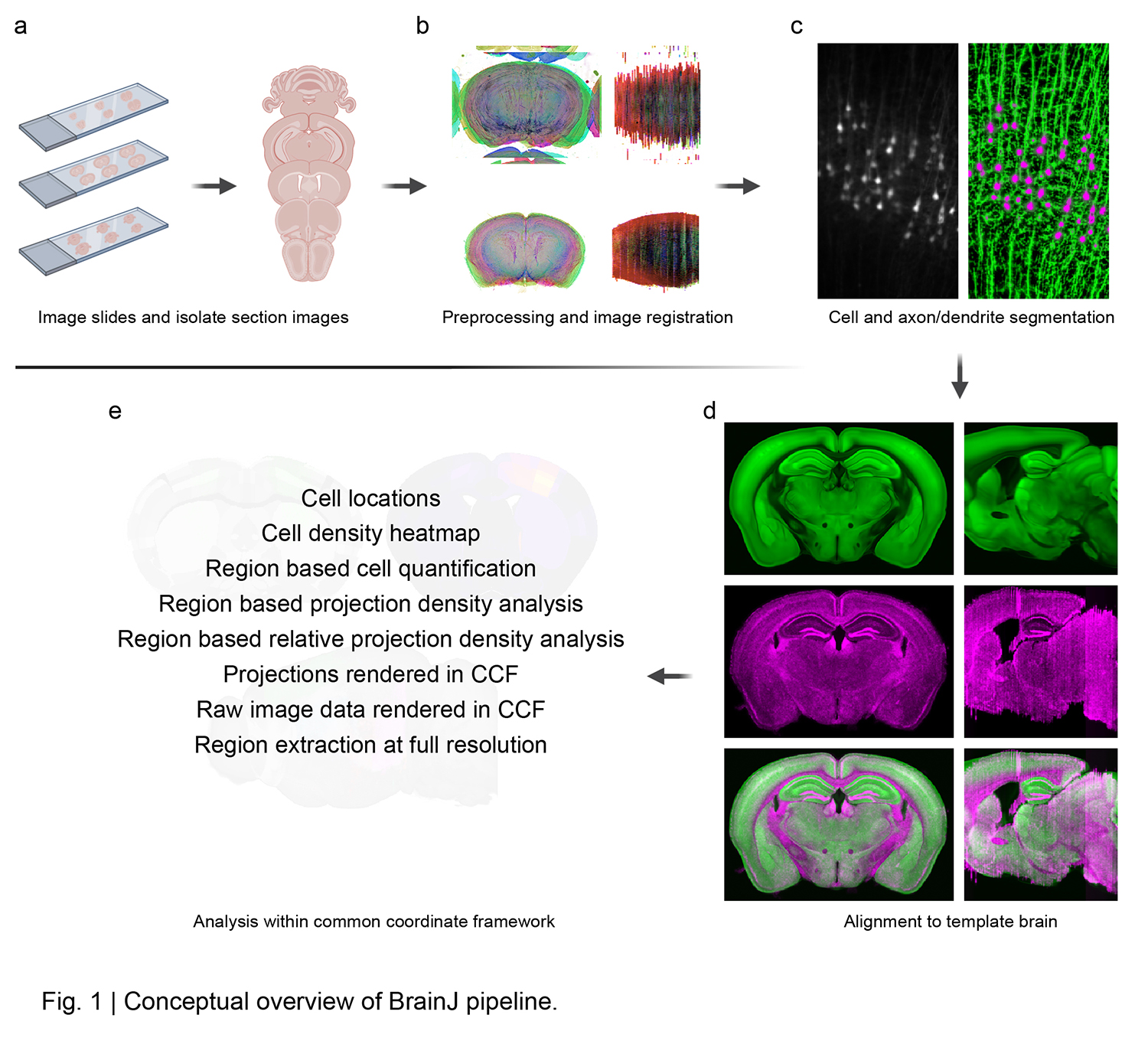
BrainJ was developed at the Zuckerman Mind Brain Behavior Institute at Columbia University to make whole-brain reconstruction and analysis accessible to bench scientists working with confocal microscopes and slide scanners. It integrates open-source tools, including Ilastik for machine-learning pixel classification, into a single Fiji-based workflow that minimizes manual intervention and supports high-throughput processing.
Capabilities
- Automatic reconstruction and registration of whole brains from slide scanner and confocal data.
- Alignment to the Allen Brain Atlas and the Enhanced Unified Atlas (Kim et al., 2019).
- Cell mapping within the common coordinate framework, including detection by machine learning with Ilastik.
- Mesoscale mapping of axonal and dendritic projections within the common coordinate framework.
- Visualization and measurement of probe and GRIN lens placement, lesions, and injection volumes.
Citation
Botta P, Fushiki A, Vicente AM, Hammond LA, Mosberger AC, Gerfen CR, Peterka D, Costa RM. An amygdala circuit mediates experience-dependent momentary arrests during exploration. Cell 183(3), 605-619 (2020).